
Last updated: May 2026 · 10 min read
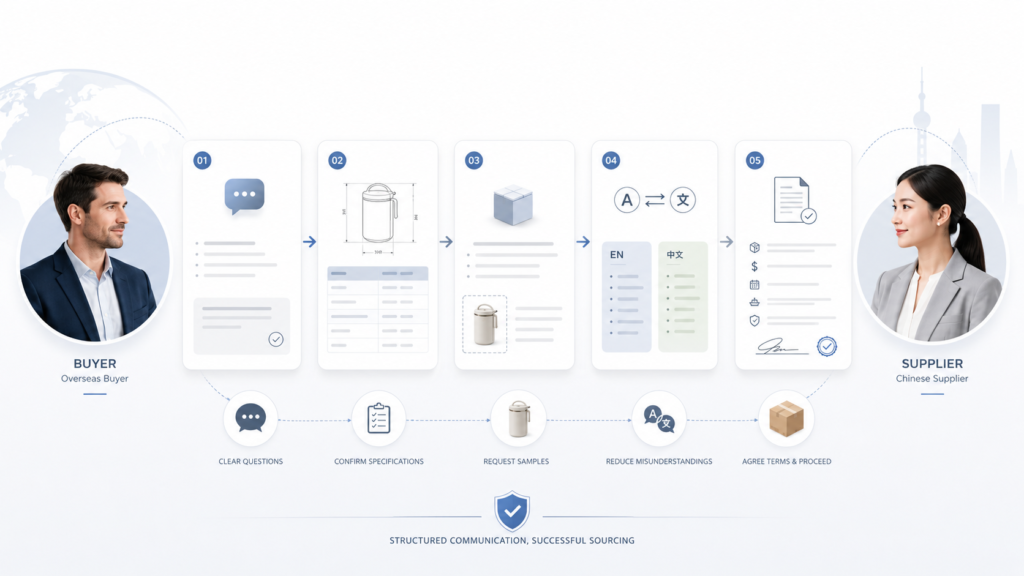
Most communication problems with 1688 suppliers are not caused by language barriers alone. They are caused by unclear specifications, vague questions, and messages that require interpretation rather than a direct answer.
A supplier who receives a clear, specific message in plain language — even through translation — can usually respond usefully. A supplier who receives a vague inquiry about “best price” or “good quality” cannot give you anything actionable.
This guide covers how to write messages at each stage of the ordering process, with templates in both English and Simplified Chinese you can adapt for your own orders.
What You’ll Learn
- How to write first contact messages that get real responses
- Message templates for inquiry, sample request, bulk order, and problem follow-up
- Simplified Chinese versions of each template
- How to write effectively for translation
- Red flags in supplier responses
- When direct communication works and when an agent is better
The Reality of 1688 Supplier Communication
1688 suppliers communicate primarily in Chinese. Many 1688 suppliers primarily serve domestic Chinese buyers, and not all of them have a clear process for overseas inquiries.
This does not mean communication is impossible. Google Translate and similar tools handle basic business communication reasonably well. Many suppliers use translation tools on their side too. The key is adjusting how you write:
- Use short sentences — one idea per sentence
- Ask one question per message where possible
- Use numbers and specifications instead of descriptive language
- Confirm everything in writing, even things discussed verbally or via screenshot
Before You Write: What to Prepare
Before contacting any 1688 supplier, have the following ready:
- The product URL on 1688
- Your target quantity for a sample and for bulk
- Your specifications — material, size, color, any customization
- Your destination country
- Whether you need a sourcing agent to handle the China side
If you do not have your specifications written down, write them first. A supplier can only answer what you actually ask.
→ How to Vet a Chinese Supplier: A 30-Minute Checklist
Also: avoid opening messages by saying you are completely new to importing or unsure how the process works. You do not need to pretend to be a large buyer — but your message should sound organized. A useful framing:
“I am evaluating suppliers for a small test order. If quality is acceptable, I may place repeat orders.”
This is honest and signals you are a serious buyer.
Translation-Friendly Writing Rules
Before using any template, write in a way that translates cleanly:
| Instead of writing | Write this instead |
|---|---|
| Can you give me your best price? | What is the unit price for 200 units? |
| Is the quality good? | What material is used? What is the weight? Can you send real product photos? |
| I need this ASAP | What is the lead time for 200 units? |
| Can you make it like this? | Can you make the product with these specifications: [list]? |
| We’re a small company just starting out | We are evaluating suppliers for a test order of [quantity] units |
Short sentences. Specific numbers. Concrete questions.
Stage 1: First Contact — Initial Inquiry
Your first message has one job: confirm whether this supplier can produce what you need at a price worth exploring.
Keep it short. Ask specific questions. Do not negotiate price in the first message — you need to confirm stock, pricing, and lead time before you know what to negotiate toward.
English Template
Hello,
I am interested in [product name]. I found your store on 1688: [product URL].
I am a buyer based in [your country]. I am looking to order a sample of [1–3] units first. If the sample quality is acceptable, I may place a bulk order of [quantity] units.
Please confirm:
- Is this product currently in stock?
- What is the unit price for [quantity] units?
- What is the sample price per unit?
- What is the domestic shipping cost to [China address or “a freight forwarder’s warehouse in China”]?
- What is the production lead time for [quantity] units?
Thank you.
Simplified Chinese Template
您好,
我对这款产品感兴趣,在1688上看到的:[产品链接]。
我是来自【国家】的买家,想先订购【1–3】个样品。如果样品质量合格,后续可能下【数量】件的批量订单。
请确认以下信息:
- 这款产品现在有现货吗?
- 【数量】件的单价是多少?
- 样品单价是多少?
- 发到【中国地址/货代仓库】的国内运费是多少?
- 【数量】件的生产交货期是多久?
谢谢。
Stage 2: Sample Request
If the supplier responds usefully and passes your vetting checklist, the next step is requesting a sample. Your sample request should confirm all specifications in writing — do not assume the supplier remembers a previous conversation.
English Template
Hello,
Thank you for your response. I would like to order a sample before placing a bulk order.
Sample details:
- Product: [name]
- Quantity: [1–3 units]
- Specifications: [color, size, material, any customization]
- Packaging: [individual box / poly bag / no requirement]
- Ship to: [your address or agent’s warehouse address in China]
Please confirm:
- Sample price per unit
- Domestic shipping cost to [address]
- Estimated delivery time to that address
- Payment method accepted for the sample
Thank you.
Simplified Chinese Template
您好,
感谢您的回复。在下批量订单之前,我想先订购样品。
样品信息:
- 产品:【产品名称】
- 数量:【1–3】件
- 规格:【颜色、尺寸、材质、定制要求】
- 包装:【单独装盒 / 塑料袋 / 无特殊要求】
- 发货地址:【您的地址或货代仓库地址】
请确认:
- 样品单价
- 发到上述地址的国内运费
- 预计送达时间
- 样品付款方式
谢谢。
Stage 3: Bulk Order Confirmation
Before paying for a bulk order, confirm everything in one message. Do not assume details from the sample stage carry over automatically.
English Template
Hello,
I am ready to place a bulk order based on the approved sample from [date].
Order details:
- Product: [name and SKU if applicable]
- Quantity: [number] units
- Specifications: [same as approved sample — please confirm no changes]
- Packaging: [requirement]
- Deliver to: [agent’s warehouse address in China]
- Requested production completion date: [date]
Please confirm:
- Total price for [quantity] units in RMB
- Production lead time
- Domestic shipping cost to [address]
- Payment method and account details
- Refund or replacement policy if goods do not match the approved sample
Thank you.
Simplified Chinese Template
您好,
我准备基于【日期】确认的样品下批量订单。
订单信息:
- 产品:【产品名称及SKU(如有)】
- 数量:【数量】件
- 规格:【与已确认样品一致,请确认无变化】
- 包装:【要求】
- 发货地址:【货代仓库地址】
- 希望完成生产日期:【日期】
请确认:
- 【数量】件的总价(人民币)
- 生产交货期
- 发到上述地址的国内运费
- 付款方式及账户信息
- 如货物与确认样品不符,退款或补货政策
谢谢。
Stage 4: Problem or Sample Issue Follow-Up
If a sample arrives with problems, document them clearly before contacting the supplier.
English Template
Hello,
We received the sample and reviewed it against our specifications. Thank you for sending it.
We found the following issues:
- [Issue 1] — see attached photo
- [Issue 2] — see attached photo
- [Issue 3] — see attached photo
Please confirm:
- What caused each issue?
- Can these be corrected in the next sample and in bulk production?
- Can you send a revised sample showing the corrections?
Thank you.
Simplified Chinese Template
您好,
我们已收到样品并按规格进行了检查,感谢您的发货。
我们发现以下问题:
- 【问题1】——见附图
- 【问题2】——见附图
- 【问题3】——见附图
请确认:
- 上述问题的原因是什么?
- 这些问题能在下一个样品和批量生产中改正吗?
- 能否发送改正后的样品?
谢谢。
→ For a full sample evaluation checklist, see: How to Order Product Samples from China
Handling Common Communication Situations
When a supplier is slow to respond
If a supplier consistently takes more than 2–3 business days to respond to a simple question, note it — slow pre-order communication often predicts slow problem resolution after payment.
“Hello, I sent a message on [date] and have not received a response. I am interested in placing an order and have a few questions. Please reply when you are available. Thank you.”
中文版
您好,我于【日期】发送了一条消息,尚未收到回复。我有意下单,有几个问题想确认。请方便时回复。谢谢。
When a supplier sends a generic price list
Reply by restating your specific questions:
“Thank you for the information. I have a few specific questions: [restate questions]. Please reply to each question directly. Thank you.”
中文版
感谢您的回复。我有几个具体问题需要确认:【重新列出问题】。请逐一回答,谢谢。
When a supplier pushes you to pay quickly
Pressure to pay before specifications are confirmed or questions are answered is a red flag.
“I would like to confirm the product specifications and sample details before making any payment. Please answer my previous questions first. Thank you.”
中文版
在付款前,我需要先确认产品规格和样品细节。请先回答我之前的问题。谢谢。
When communication moves to WeChat or WhatsApp
Moving to WeChat or WhatsApp is common and not automatically a problem. The risk begins when a supplier refuses to confirm key terms in writing, pushes payment to a personal account, or avoids documenting specifications, price, lead time, and replacement terms.
Keep all important confirmations — pricing, specifications, lead time, refund policy — in writing, regardless of which platform you use.
Red Flags in Supplier Responses
Vague answers to specific questions
If you ask “what is the unit price for 200 units?” and receive “price depends on quantity, please contact us,” that is not an answer.
Pressure to pay before specifications are confirmed
Rushing payment before the order is documented is a consistent pattern in problematic transactions.
Pressure to move payment to a personal account
Refusing written order confirmation while pushing off-platform personal account payment — rather than a business account — is a significant risk signal, especially early in a new relationship.
Inconsistent information
Prices, lead times, or specifications that change between messages without explanation.
Inability to answer basic product questions
If a supplier cannot tell you the material, weight, or dimensions of their own product, they may not manufacture it.
Excessive promises without pushback
A supplier who immediately agrees to every specification, price, and timeline without any qualification may be telling you what you want to hear.
When Direct Communication Works — And When It Does Not
Direct communication works when:
- Your order is straightforward with no complex customization
- The supplier responds clearly and specifically
- You can confirm all details in writing
- A sourcing agent receives the goods and handles China-side logistics
Direct communication becomes difficult when:
- Specifications are complex or require technical verification
- There is a dispute over quality or a damaged shipment
- The supplier is evasive or unresponsive
- You are coordinating multiple suppliers
- You need compliance documentation or certifications
For these situations, a sourcing agent who communicates in Chinese adds significant value.
→ How to Pay 1688 Suppliers from Outside China
A Note on Communication via Sourcing Agents
If you are using a sourcing agent, most supplier communication goes through them. Your job becomes providing clear specifications to your agent and reviewing what they report back.
Even with an agent, write your specifications clearly and in writing. An agent can only communicate what you tell them. If your brief is vague, the agent’s communication with the supplier will be vague — and the results will reflect that.
Your Next Step
Good supplier communication starts before you send the first message. Vet the supplier first — confirm their registration history, transaction volume, and response rate before investing time in a conversation.
→ How to Vet a Chinese Supplier: A 30-Minute Checklist →
Educational content only. Supplier communication practices, platform features, and translation tools change. Results vary by supplier and situation.
Before you contact any supplier, make sure they are worth contacting.
Use the 30-minute Supplier Verification Checklist before starting any supplier conversation.
Download the Free Checklist →