
Last updated: May 2026 · 11 min read
The price a supplier quotes you is not your cost.
This is the single most common financial mistake new importers make. They see a unit price of $4, sell the product for $12, and assume they’re making $8 per unit. Then the shipment arrives, the customs bill comes in, and the real math looks nothing like what they planned.
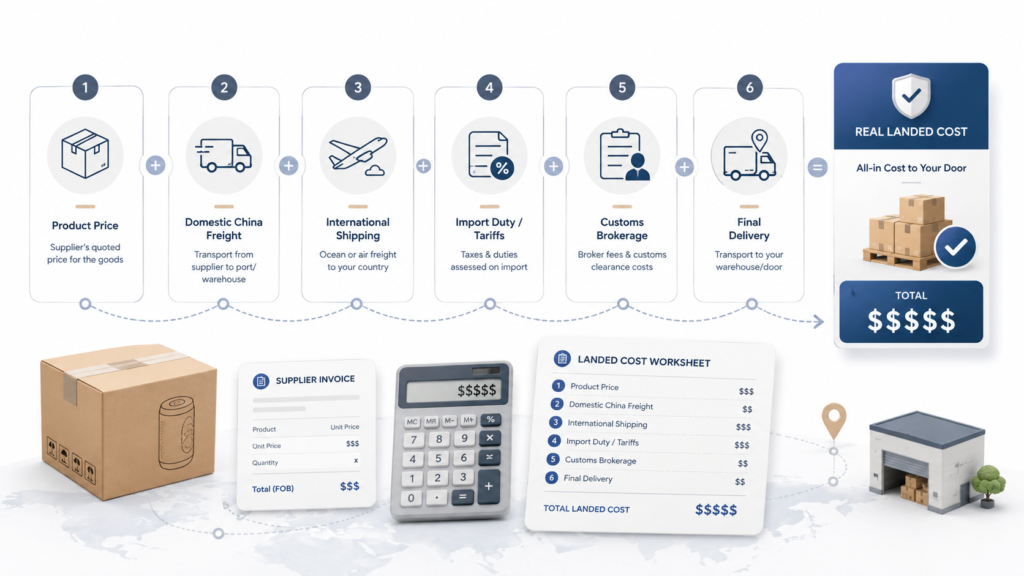
Landed cost is the total amount it costs to get a product from a factory in China to your warehouse or fulfillment center. It includes everything between “the supplier sends the goods” and “the goods are in your hands.” If you don’t calculate it before placing an order, you don’t know your actual margin — and you may not have one.
This guide walks you through every component of landed cost, shows you how to estimate each one, and gives you a working example you can adapt for your own products.
What You’ll Learn
- What landed cost is and why the supplier’s price is only the starting point
- Every cost component between factory and your warehouse
- How to understand Incoterms and who pays what
- How to estimate each component before you place an order
- A worked example showing full landed cost calculation
- How to use landed cost to set a minimum viable price
- Why landed cost is not the same as your total business cost
Why This Matters Before You Negotiate
Most new importers negotiate price first, then figure out the full cost later. This is backwards.
If you don’t know your landed cost ceiling before you enter a price discussion, you don’t know what you’re actually negotiating toward. You might successfully negotiate a supplier down from $5 to $4.50 — and still lose money on every unit because you didn’t account for freight, duty, and customs fees.
Calculate landed cost first. Then negotiate. Then decide whether the product is viable.
The Components of Landed Cost
Landed cost has seven components. Some are fixed; some vary by freight mode, order size, and product category. We’ll go through each one.
Component 1: Product Cost (Ex-Factory Price)
This is the unit price the supplier quotes you, multiplied by the number of units.
Example: $4.50 per unit × 200 units = $900
This is the number everyone focuses on. It is the starting point of the story, not the end.
Understanding Incoterms
Every supplier quote comes with a trade term — called an Incoterm — that defines who is responsible for which costs and at what point. New importers often receive a price without knowing which Incoterm applies. Here are the most common ones:
| Incoterm | What It Usually Means for a Beginner |
|---|---|
| EXW (Ex Works) | You pay almost everything after goods leave the factory — including domestic China trucking to the port. Often not ideal for beginners without a strong freight forwarder. |
| FOB (Free On Board) | Supplier handles export-side delivery to the named port and loads goods onto the vessel. You pay international freight, import duty, customs, and destination charges. The most common term for ocean shipments. |
| CIF / CFR | Supplier arranges ocean freight to the destination port, but you still handle import customs and destination charges. |
| DDP (Delivered Duty Paid) | Supplier or forwarder quotes a delivered price including many import-side costs. Understand exactly what is — and is not — included before accepting this term. |
Always confirm the Incoterm in writing before finalizing any order.
Component 2: Domestic China Freight
Getting goods from the factory to the export port in China.
Who pays: Under FOB, the supplier typically handles this and may build it into their price. Under EXW, you pay separately — through a freight forwarder or sourcing agent.
Typical planning range: $30–$150 for small shipments, depending on distance from factory to port and shipment weight/volume.
How to estimate: Confirm whether your supplier’s price is FOB or EXW. If EXW, ask for a separate inland freight quote to the nearest major port (Shanghai, Shenzhen, Guangzhou, and Ningbo are most common).
Component 3: International Freight
Shipping from the Chinese port to your destination.
| Freight Mode | Typical Use Case | Speed | Rough Cost Range |
|---|---|---|---|
| Express courier | Samples, urgent shipments, usually under 50kg | 3–7 days | $5–$15/kg |
| Air freight | Time-sensitive orders, often 50–500kg | 5–10 days | $3–$8/kg |
| Sea freight LCL | Small ocean shipments, under ~15 CBM | 20–40 days | $80–$200/CBM |
| Sea freight FCL | Large orders filling a 20ft or 40ft container | 20–40 days | $1,500–$4,000/container |
For a first order of 200 units of a typical consumer product, express courier or air freight is usually the most practical choice. Sea freight LCL consolidation fees can be higher than expected for very small shipments, and minimum volumes apply.
Sea vs. Air vs. Express: Full Comparison →
How to estimate: Get quotes from 2–3 freight forwarders before placing your order. Provide estimated weight and dimensions. Most will respond within 24–48 hours.
Component 4: Import Duty
The tax charged by customs based on product type and declared value.
In the United States, import duty is determined by the HTS code (Harmonized Tariff Schedule code) — a 10-digit number classifying every importable product. Each code has an associated duty rate.
How to find your HTS code:
- Go to hts.usitc.gov
- Search for your product by description
- Identify the most accurate 10-digit classification
- Note the “General” duty rate
Example only (not classification advice): A simple ceramic mug may fall under a ceramic tableware heading, but the exact HTS code depends on material, design, intended use, and official classification details. Do not copy an example code into your customs entry without verifying it applies to your specific product.
For products sourced from China, also check Section 301 tariffs. These are additional duties on Chinese-origin goods. Rates vary by product category — not all China-origin goods are covered at the same rate. Some products are not covered; some have different rates; exclusions or updates may apply. Check the current trade remedy status for your specific HTS code before ordering.
How duty is calculated:
For U.S. imports, customs value is generally based on transaction value — the price actually paid or payable for the goods when sold for export to the United States. Certain additions or deductions may apply depending on your transaction. Do not assume your commercial invoice amount is always the final customs value.
Always verify current rates at hts.usitc.gov and cbp.gov before placing any order.
Component 5: Customs Brokerage Fee
The fee paid to a licensed customs broker to process your shipment through customs entry.
Typical planning range:
- Express courier brokerage: $15–$50 per shipment (often itemized on the courier invoice)
- Licensed customs broker: $75–$200 per entry for straightforward shipments
For your first few orders, using a freight forwarder who includes customs brokerage is the most practical approach. Self-filing a formal entry requires an Importer of Record number, knowledge of ACE (Automated Commercial Environment), and correct HTS classification — not recommended for first-time importers.
Component 6: Port and Destination Charges
Fees charged at the destination port or airport. These vary by port, freight mode, and market conditions.
Common charges to ask your freight forwarder about:
- ISF filing fee (US ocean imports) — Required; typically $25–$50
- Destination handling charge — $50–$150 per shipment
- Drayage (trucking from port to warehouse) — $150–$400 depending on distance
- Warehouse handling — If using a 3PL or prep center
Ask for a full cost breakdown — including all origin and destination charges — when requesting a freight quote. These charges commonly appear on the forwarder’s invoice after the fact if you don’t ask upfront.
Component 7: Last-Mile Delivery
Getting goods from the destination port or warehouse to your final location.
If shipping to Amazon FBA: Factor in prep center fees for labeling and packaging ($0.50–$2.00 per unit depending on services), plus Amazon’s receiving and storage fees.
If shipping to your own address or warehouse: Factor in any storage and handling costs.
Putting It Together: A Worked Example
| Cost Component | Calculation | Amount |
|---|---|---|
| Product cost | 200 units × $4.50 | $900.00 |
| Domestic China freight | Included in FOB price | $0.00 |
| Air freight | ~35kg × $6/kg (estimated) | $210.00 |
| Standard import duty | $900 × 9.8% (example rate) | $88.20 |
| Section 301 tariff | $900 × 15% (example rate) | $135.00 |
| Customs brokerage fee | Flat fee (estimated) | $85.00 |
| Destination handling charges | Estimated | $80.00 |
| Prep center fee | 200 units × $1.00 | $200.00 |
| Total landed cost | $1,698.20 | |
| Per unit landed cost | $1,698.20 ÷ 200 | $8.49 |
The supplier quoted $4.50. The estimated landed cost in this example is $8.49 — nearly double.
If you planned to sell this product at $14.99, your gross margin per unit is approximately $6.50, not $10.49. If you planned to sell at $9.99, you may have little or no margin left after marketplace fees and returns.
How to Use Landed Cost to Set Your Minimum Price
Once you know your landed cost, you can calculate your minimum viable selling price.
Example:
- Landed cost: $8.49 per unit
- Target gross margin: 40%
- Minimum selling price: $8.49 ÷ (1 − 0.40) = $8.49 ÷ 0.60 = $14.15
This means you need to sell at $14.15 or above to hit a 40% gross margin on landed cost alone.
Important: This formula gives you a minimum price before marketplace fees, advertising costs, returns, storage, and taxes. If you sell on Amazon, Etsy, Shopify, or another platform, run a second calculation after platform fees. A product can clear the landed cost threshold and still not be profitable once all selling costs are included.
Landed Cost Is Not Your Total Business Cost
Landed cost tells you what it costs to get the product into your hands. It does not include every cost of selling it.
Before deciding a product is profitable, also consider:
- Marketplace referral fees (Etsy, Amazon, eBay typically charge 6–15% of sale price)
- Amazon FBA fees or third-party fulfillment fees
- Payment processing fees
- Advertising and promotional spend
- Storage fees for slow-moving inventory
- Returns and damaged inventory
- Product photography, packaging design, and inserts
A product can have a strong landed cost and still fail if the selling costs are too high for the price the market will bear. Landed cost is the foundation — not the full picture.
Common Mistakes When Calculating Landed Cost
Forgetting Section 301 tariffs. Many new importers look up the standard HTS duty rate and stop there. Section 301 tariffs are separate and often larger. Always check both, and verify the current trade remedy status for your product.
Using the wrong Incoterm. If your supplier quotes EXW and you assume FOB, you are missing the domestic China freight cost. Confirm the Incoterm in writing before finalizing any price agreement.
Ignoring destination charges. Freight quotes often show origin-to-port costs only. Destination handling, drayage, and last-mile costs can add $200–$400 or more to a small shipment.
Using outdated freight rates. Freight markets fluctuate significantly. A rate from six months ago may be well off current market. Always get a fresh quote for any real order.
Calculating duty on the wrong base. Duty is calculated on the customs value of the goods — typically the invoice price — not on your total landed cost. Apply the duty rate to the correct number.
Assuming landed cost equals your total profit picture. Landed cost is your cost to acquire the product. Platform fees, advertising, returns, and storage all come after. Account for them before deciding a product is viable.
Calculate Your Own Landed Cost
SoloImporter has a free tool to help you run through this calculation for your own products.
Use the free Landed Cost Calculator
Walk through each component and get an estimated landed cost per unit — before you commit to any order.
Open the Calculator →Your Next Step
Now that you know how to calculate your real cost, the final step before your first order is learning how to evaluate samples — the physical check that confirms your supplier can deliver what you agreed on paper.
Continue to Step 5: How to Order Product Samples from China →
Continue Reading
These are the next steps in the sourcing path.
Calculate your real product cost
Free landed cost calculator — walk through every component before you order.
Open the Calculator →Still choosing a supplier?
Download the free Supplier Verification Checklist before placing your first order.
Download the Checklist →